The 5 mistakes every new pickleball player makes (and how to fix them in one session)
May 4, 2026
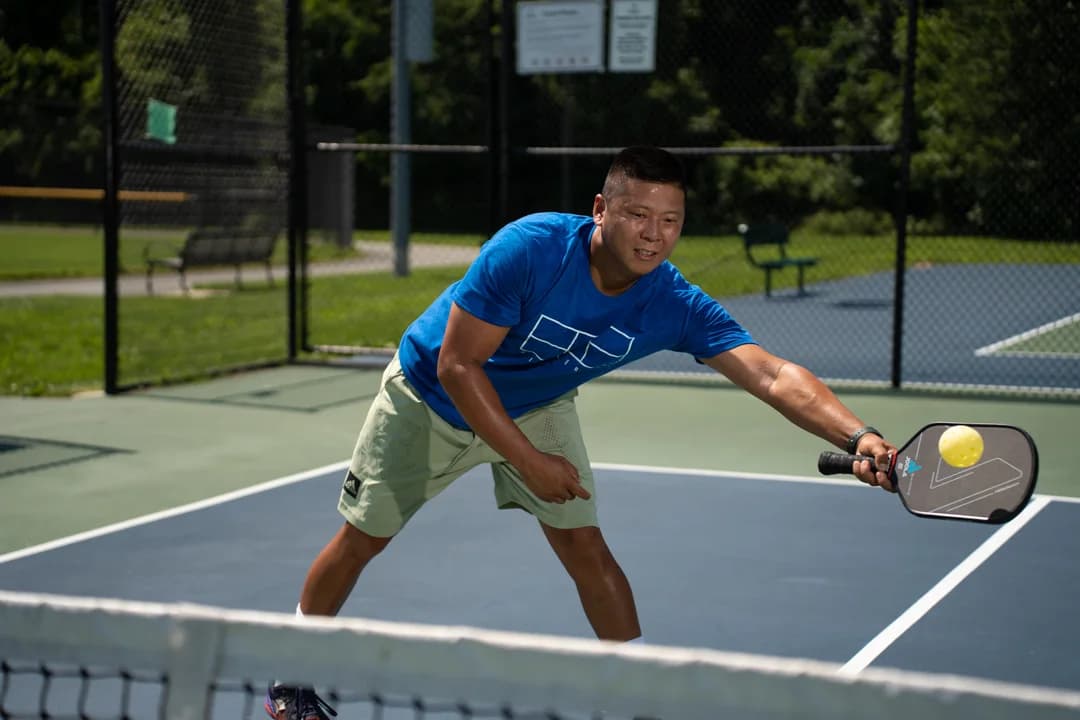
If you've played pickleball more than three times, you have already developed at least two of the five habits that will cap your game at 2.5 forever.
That's not a bad thing. It just means you're like every other beginner I've coached. The good news: all five are fixable in a single 60-minute session. Most of them are mental, not physical.
Here they are, in order of how much they're costing you.
Mistake 1: You stay at the baseline.
The single biggest mistake new players make: they treat pickleball like tennis. They hit the ball and stay back. They wait for the next shot from the baseline. They get into rallies from 22 feet away from the kitchen line.
You can't win pickleball from the baseline. Period. The entire sport is designed around the kitchen line — the line 7 feet from the net. The team that gets to that line first wins 70%+ of points.
After you return a serve, your job is to get to the kitchen line as fast as possible. Not eventually. Not "if the rally lets me." Immediately, behind a third-shot drop or a return.
Fix: For your next session, repeat one rule out loud after every shot: "Move forward." You'll feel ridiculous. You'll also win twice as many points.
Mistake 2: You're death-gripping the paddle.
Hold your paddle like you'd hold a baby bird. Tight enough that it won't fly away. Loose enough that you're not crushing it.
Most beginners hold the paddle at a 9 or 10 out of 10 grip pressure. That works for power. It kills every soft shot in the sport — drops, dinks, resets, blocks. And those are 70% of the shots you need to play.
A 4 or 5 out of 10 grip is what you want. Soft hands. The paddle does the work, not your forearm.
Fix: Spend 5 minutes of your next session intentionally holding the paddle "too loosely." You'll mishit a few. You'll also feel — for the first time — what it's like to actually drop a ball softly into the kitchen.
Mistake 3: You're trying to hit winners.
Every beginner thinks the goal of each rally is to hit a winner. So they go for the line. They try to power past their opponents. They aim for tiny gaps.
Here's the truth: at 2.0, 2.5, and even 3.0, you don't need to hit winners. You just need to not lose the rally. Your opponents will give you the point. Almost every rally at this level ends with an unforced error, not a winner. The team that makes one fewer error wins the game.
Fix: For one game, set a rule: every shot has to land safely in the court. No going for lines, no trying to hit past anyone. Just hit good, deep, controlled shots. You'll win more games than you ever have.
Mistake 4: You don't actually understand the kitchen rule.
The kitchen (non-volley zone) rule confuses every beginner. Most players overcorrect — they treat the kitchen like lava and refuse to go in.
Here's what the rule actually says:
Most beginners avoid the kitchen entirely. That's a mistake. You should be standing right at the kitchen line, paddle up, ready. The kitchen isn't a danger zone — it's just a spot you can't volley from.
Fix: Stand with your toes touching the kitchen line. Stay there. The whole rally. You'll be in position for every dink, drop, and counter-attack.
Mistake 5: You're watching your own ball.
You hit a ball. You watch it sail across the net. You watch your opponent set up. By the time the ball is coming back, you're flat-footed and reaching.
Better players watch the opponent — their body, their paddle face, their feet — to predict where the ball is going. Worse players watch their own ball, which doesn't tell them anything.
Fix: As soon as you finish your shot, snap your eyes off the ball and onto your opponent's paddle. You'll feel like you're missing the ball at first. You'll quickly find that you're getting to balls you used to reach for.
How to fix all five in one session
You can fix every one of these in a single 60-minute private lesson. I do it every week with brand-new players. We'll spend 10–15 minutes on each, starting with whichever one is leaking the most points (usually #1 or #3).
By the end of the session, you'll feel like a different player. You won't be a 3.5 — that takes months — but you'll stop bleeding points to habits that have nothing to do with skill.
If you've played a few times and you're ready to actually get good, book a private lesson. I'll watch you play, name which of the five is costing you the most, and lay out a plan to fix it.
Want to work on your game with Coach Sam?
See Coaching Options →